
Wastewater Treatment in the sugar industry
Sector Overview
The sugar industry produces large volumes of wastewater with a high organic load. Targeted treatment is therefore essential to comply with statutory discharge limits and to reuse water within the plant. At the same time, efficient treatment helps to reduce costs and environmental impact. On this page, you will find an overview of the available processes and solutions to help you find the right solution for your business.

Wastewater Treatment in the Sugar Industry
Sektorüberblick
Inhalt
Sources of sugar factory wastewater
The processing of beet (during the campaign) generally takes place from September to December. Specific environmental impacts arise throughout the entire sugar production process, which must be taken into account when planning the treatment.
Wastewater streams in sugar production
| Production step | Production component | Substances present in the wastewater |
|---|---|---|
| Transport and fluming | Flume channels, beet reception | Soil, sand, stones, leaves, organic solids |
| Washing and slicing | Beet washing plant, cutting machines | Fine soil, plant residues, cell material, wash water |
| Extraction with hot water | Beet pulp, raw juice | Sugar residues, dissolved organic substances |
| Juice purification with lime and CO2 | Milk of lime, carbonate sludge, thin juice | Calcium compounds, precipitated non-sugar substances |
| Evaporation | Evaporation station, thick juice | Condensate, excess condensate, organic traces |
| Crystallisation | Boiling station, condenser water | Heated condenser water, syrup residues |
| Centrifugation | Sugar, mother liquor, molasses | Sugar and molasses residues |
The majority of the wastewater is generated during the washing and transport of the beet. This water mainly contains mineral solids such as soil, as well as organic matter from plant residues. Further down the production line, wastewater containing organic matter is generated primarily from the extraction and juice purification processes. This wastewater contains, in particular, sugar residues, dissolved organic matter and calcium compounds.
The total water requirement is approximately 1.1 m³ to 1.74 m³ per tonne of beet.
Using a modern recirculation system, the volume of wastewater produced is reduced to approximately 0.8 m³ per tonne of beet.
Composition of wastewater in sugar factories
Wastewater from sugar factories has a very high organic load, whilst the nitrogen and phosphorus content is comparatively low.
In addition to the organic load, calcium plays an important role. In Germany, lime milk is added to the wash water and during juice purification. As a result, the wastewater has elevated calcium levels. The solids from beet washing continue to be a major source of pollution.
However, there are differences depending on the processed product:
Sugar beet processing:
COD: 3.000 – 6.600 mg/l
BOD: 3.500 – 4.000 mg/l
N: 10 – 44 mg/l
P: approx. 3 mg/l
Solids: up to approx. 6.000 mg/l (high proportion of soil due to beet washing)
Ca: 400 mg/l (due to the use of lime milk)
pH: approx. 7 – 8
Overall, sugar beet wastewater is highly biodegradable.
Sugar cane processing:
COD: 1.100 – 12.200 mg/l
BOD: 350 – 5.100 mg.l
N: 15 – 40 mg/l
P: 1 – 12 mg/l
Solids: 760 – 9.000 mg/l
pH: 5 – 9.5
Ca: up to approx. 2.400 mg/l
Cl: up to approx. 3.000 mg/l
In sugar cane processing, there are significantly greater fluctuations than in beet sugar production. In addition, much higher COD values and often higher salt and calcium contents are observed.
During campaign operations, these values continue to rise in partially closed loops.
Why wastewater treatment is beneficial for your company
Wastewater treatment is, first and foremost, a matter of regulatory compliance. In sugar production, the wastewater generated must meet the minimum discharge requirements.
However, it is also economically beneficial. By implementing water recirculation, both freshwater demand and wastewater volumes can be significantly reduced. This lowers the need for new water and relieves internal process cycles.
In addition, elevated calcium levels limit water savings. If calcium concentrations are too high, precipitation cannot be prevented and costly removal becomes necessary. A well-designed treatment concept therefore also protects against subsequent operational costs.
Furthermore, seasonal campaign operation plays a role. In partially closed loop systems, concentrations continuously increase. Without a coordinated treatment approach, the risk of failing to meet discharge targets rises accordingly.
Options for wastewater treatment in sugar factories
Wastewater treatment is carried out in several coordinated stages. The aim is to reduce solids, organic load and nutrients.

Mechanical pre-treatment
Mechanical pre-treatment is used to remove coarse solids from the wastewater. Stones, sand and beet residues are removed via screening and sedimentation. In this way, deposits are prevented and disruptions in subsequent treatment stages are reduced.

For this step, the ClearFox® screw screen is a suitable solution. It represents a compact and efficient system for the mechanical pre-treatment of industrial wastewater. The system operates fully automatically: the wastewater first flows through a screen where solids are retained and then conveyed by a screw, dewatered and compacted. As a result, the volume of solids can be significantly reduced. The system is designed for high flow rates, requires little maintenance, and can be flexibly adapted to different requirements.
Physical and chemical treatment
At this stage, fine solids, fats and organic compounds (COD) are removed. This improves the efficiency of the biological processes.
For this purpose, the pre-treated wastewater stream is directed into a dissolved air flotation system, such as the ClearFox® dissolved air flotation (DAF). Particles previously formed by coagulation and flocculation are transported to the surface by fine air bubbles and removed there.
ClearFox® pressure-relief flotation (DAF) is a physico-chemical separation process.
This is followed by aerobic wastewater treatment, in which organic constituents are biologically degraded. Nitrification and denitrification can be added if required to specifically remove nitrogen compounds. Aerobic treatment is suitable for a wide range of applications and delivers stable results, particularly at typical COD concentrations. Alternative processes, such as anaerobic treatment, are primarily used in large-scale projects with very high loads exceeding approximately 30,000 mg/l.
The ClearFox® FBBR is designed for the treatment of pre-treated industrial wastewater and operates according to the submerged fixed-bed process. Microorganisms colonise fixed carrier materials and efficiently degrade organic and nitrogenous compounds. This ensures a high and stable treatment performance, which remains reliable even under fluctuating influent conditions, as typically encountered during campaign operation.
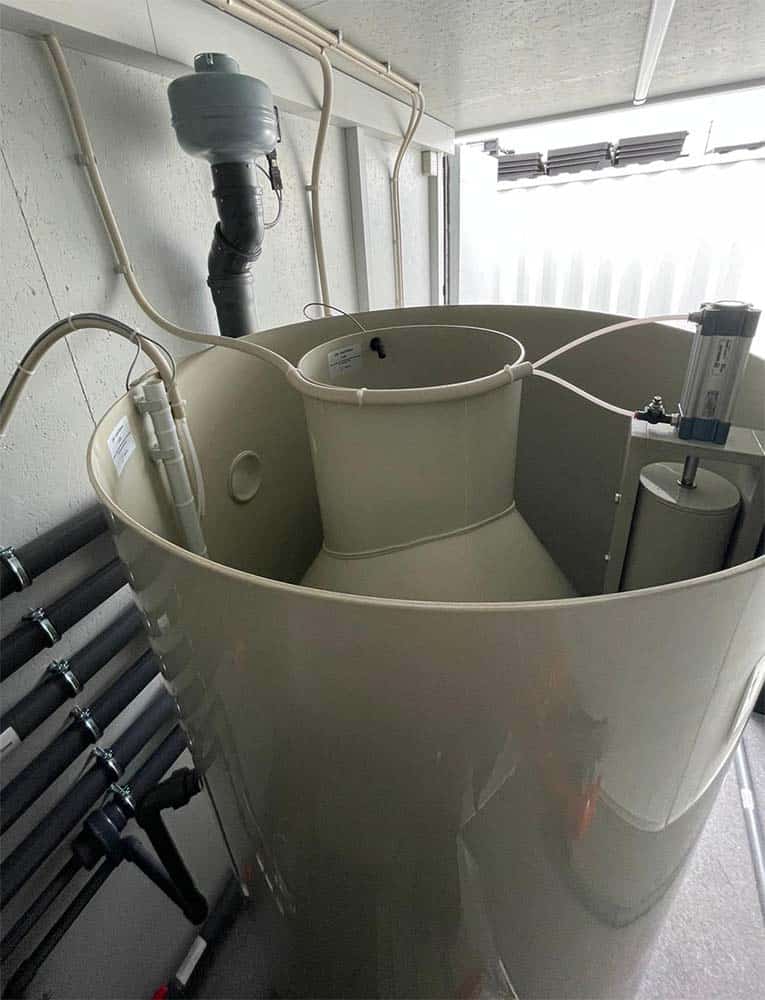
After the biological stage, sludge separation is required. The ClearFox® lamella clarifier is suitable for this purpose, reliably removing settleable solids from the effluent. The inclined lamella plates significantly improve sedimentation, allowing even finer particles to be efficiently separated and discharged as sludge.
Integrated systems and reuse
For industrial applications, modular turnkey systems are frequently used. These combine several treatment stages within a single installation. The ClearFox® containerised systems plant offers a flexible solution with integrated pre-treatment, biological treatment and final clarification.
These systems enable both discharge into the sewer system and reuse within the operation.

Utilisation of residuals from wastewater treatment
Wastewater treatment separates several reusable or disposable material streams. Their quality determines whether they can be reused, applied in agriculture or require regulated disposal.
The largest solid fraction is the settled soil from the wash water. After initial sedimentation, it occurs with a dry solids content of 20 to 25 percent. In Germany, this can be directed to sedimentation ponds for on-site treatment.
In addition, carbonate sludge is already generated during juice purification. The precipitated carbonate lime is dewatered and used as a lime fertiliser in agriculture. It is therefore one of the most important reusable by-products of the sugar factory.
Ultimately, however, the most important output is treated water. Decanted wash water and reused condensate significantly reduce freshwater demand. This represents a key benefit of wastewater treatment in sugar production.
Planning and procurement of a wastewater treatment plant for sugar factories
The planning of a wastewater treatment plant requires a detailed analysis of process conditions. The significant fluctuations during the campaign are particularly important.
The design is based on parameters such as wastewater volume, organic load and temperature. In addition, the elevated calcium content must be taken into account, as it can lead to scaling. Incorrect input data results in reduced performance and may jeopardise compliance with discharge limits. Therefore, real campaign data, pollutant loads and recirculation rates should be verified prior to design.
In addition to the relevant technology, we also offer precise wastewater analysis, plant design, installation, commissioning and operation.
Your benefits at a glance
With our integrated solutions and process guarantees, ClearFox® is one of the market leaders in Europe. Our modular, container-based systems allow us to adapt your wastewater treatment flexibly to your specific requirements. This results in a customised and cost-effective solution for every application.
Our focus is on:
✔ Compact design – saves valuable space
✔ Automatic operation with optional remote monitoring
✔ Low operating costs through energy-efficient process technologies
✔ Seamless on-site integration into existing systems
✔ Simple solutions for complex treatment challenges
✔ Cost-conscious design without compromising on quality
✔ Customer-oriented approach for support and satisfaction
Reliable technology with proven results
Our modular process stages – including dissolved air flotation (DAF) and the fixed-bed process (FBR) – have been independently tested and certified by PIA GmbH.
✔ Lowest operating costs on the market
✔ Modular & scalable systems
✔ Leasing options available for short-term or pilot projects
We understand wastewater from the sugar industry
Every processing plant generates a unique wastewater profile. Therefore, it is essential to work with a partner who understands the specific processes and challenges of wastewater treatment in the sugar industry.
We have worked with various European plants to implement efficient, cost-effective and compliant treatment systems tailored precisely to the respective operating conditions.
Global support, local expertise
Our internationally positioned ClearFox® service team provides continuous support throughout the entire project lifecycle, ensuring smooth and reliable operation – from planning through to post-commissioning.
Your project start
Have we sparked your interest? We would be happy to offer you a non-binding site analysis including a preliminary design. Loads, boundary conditions and discharge targets are assessed in order to identify a suitable solution and provide an initial cost estimate.
FAQs
Which parameters are particularly relevant in wastewater from the sugar industry?
Typical constituents include organic compounds (sugar residues), high COD and BOD values, solids from beet washing, and calcium compounds resulting from the use of lime milk. Nitrogen and phosphorus are usually present in smaller quantities.
What treatment method is usually used?
In the sugar industry, a combination of mechanical pre-treatment, optional physico-chemical treatment (e.g. DAF) and biological wastewater treatment (aerobic and anaerobic) is used. This multi-stage treatment ensures consistent and efficient results.
When is it worthwhile to reuse treated wastewater in sugar factories?
The reuse of treated wastewater in sugar factories is particularly worthwhile when strict statutory discharge limits must be met and reducing wastewater volumes brings economic benefits. In arid regions with limited groundwater resources, on-site water reuse becomes even more important. Furthermore, the construction of wastewater treatment plants is in some cases supported by subsidy schemes, which makes the investment even more attractive.
How much does a wastewater treatment plant for the sugar industry cost?
The costs depend heavily on the volume of wastewater, the level of contamination, the required effluent quality and the technology chosen. Space constraints and the degree of automation also play a significant role. With modular solutions, such as containerised systems, the capital costs are generally lower than for traditional, custom-built wastewater treatment plants.
Can an existing system be modernised rather than replaced?
Yes, in many cases existing sewage treatment plants can be optimised through targeted extensions or the retrofitting of modern technologies. This is often more cost-effective than building a completely new plant.
Reference projects




- 40.000+ Behandlungssysteme
- Installiert in über 50 Ländern
- Behandlung von 25 Millionen Litern täglich
