Industrial laundries place exceptionally high demands on wastewater treatment. Every day, they process large volumes of workwear, cleanroom garments, and textiles for the hospitality industry. These operations generate wastewater with a highly complex composition. Surfactants, fats, suspended solids, and organic compounds enter the wastewater stream alongside heavy metals and other industry-specific contaminants. Reliable wastewater treatment therefore forms the foundation for efficient operations and full regulatory compliance.
For one of Europe’s leading textile service providers, PPU Umwelttechnik GmbH developed a tailor-made solution for the treatment of industrial laundry wastewater. The facility generates approximately 22 m³ of wastewater per day. During an operating period of 7.5 hours, the treatment system handles an average flow rate of around 3 cubic metres per hour. The wastewater contains a chemical oxygen demand (COD) of approximately 2,000 mg/L and a biological oxygen demand (BOD₅) of around 900 mg/L. In addition, it contains suspended solids, surfactants, and various other contaminants originating from the laundry process.
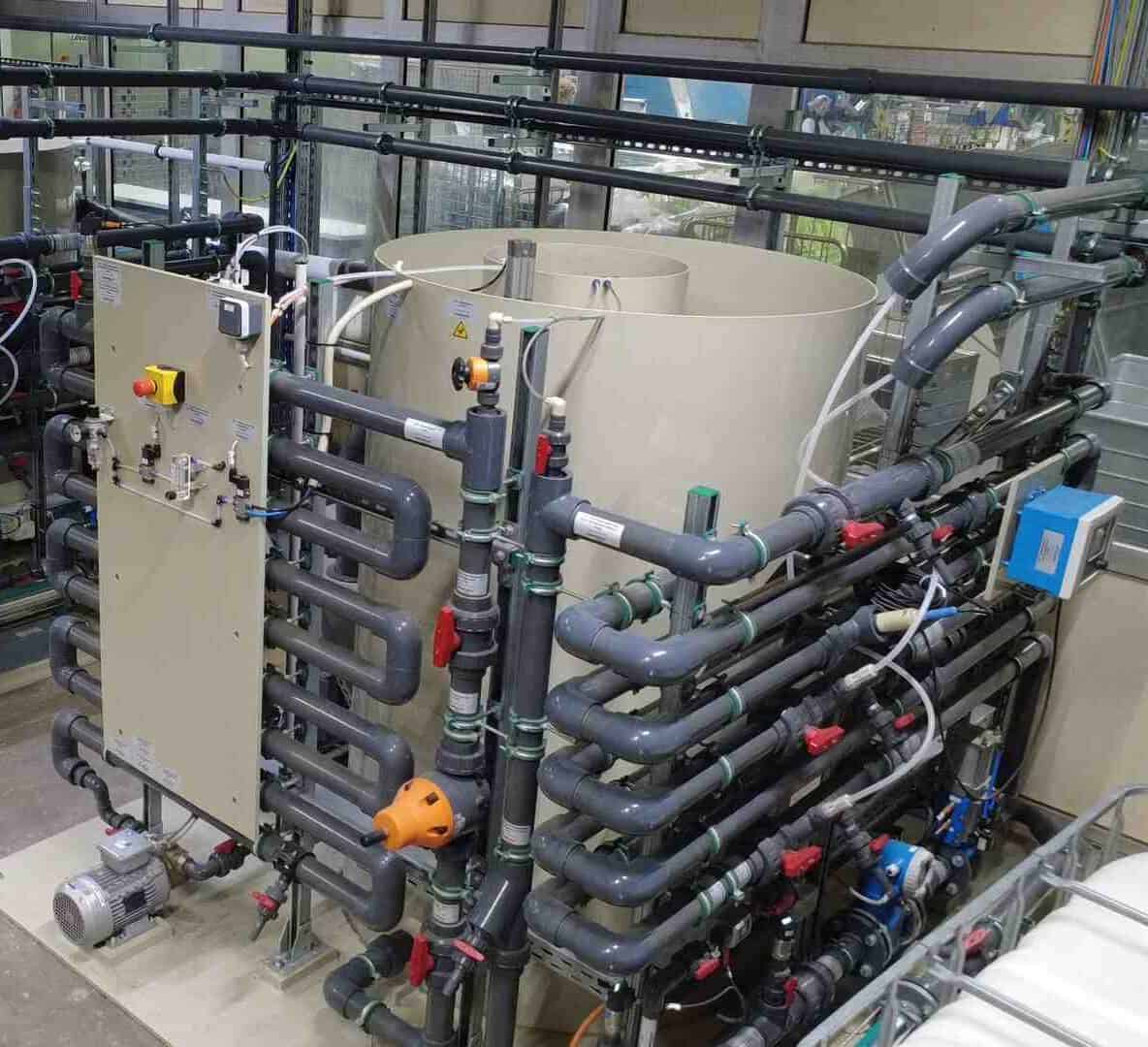
The project began with a comprehensive wastewater analysis carried out in PPU’s in-house laboratory. These results formed the basis for selecting the optimum treatment process. PPU’s engineering team then designed a wastewater treatment system specifically tailored to the site’s operational requirements. The focus was never on a standard product or a predefined installation concept. Instead, the characteristics of the wastewater and the available infrastructure determined the final system design. As a result, PPU integrated the entire treatment plant directly into the customer’s existing production hall, making efficient use of the available space while ensuring seamless integration into ongoing operations.
In addition to standard laundry services, the facility processes workwear from an industrial customer whose garments carry significant lead contamination. This heavy metal load creates a unique challenge for wastewater treatment. To prevent cross-contamination, these garments are washed separately from the regular laundry. The resulting lead-contaminated wastewater is also collected separately and stored in a dedicated equalization tank.
This process creates two distinct wastewater streams with different contamination profiles. The regular laundry wastewater is generated continuously and collected in two large mixing and equalization tanks. The lead-contaminated wastewater is stored in a separate tank before entering the treatment process at defined intervals. Both wastewater streams differ considerably in their chemical composition and pollutant load. The treatment system therefore requires a flexible process design that consistently delivers stable treatment performance under changing operating conditions.
At the same time, the treated effluent must comply with the discharge requirements defined in Annex 55 of the German Wastewater Ordinance (AbwV) before entering the public sewer network. Conventional mechanical treatment alone does not achieve these standards. The treatment process must reliably remove dissolved heavy metals, suspended solids, oils, and organic contaminants while maintaining low operating costs and minimal maintenance requirements.
The flotation sludge generated during treatment also plays a crucial role in the overall process. Dissolved Air Flotation concentrates the removed contaminants into a relatively small but highly contaminated sludge stream. Efficient sludge dewatering significantly reduces its volume, lowering transportation and disposal costs while improving the overall economics of the treatment plant. Sludge management therefore forms an integral part of the complete process concept.
PPU developed a customized wastewater treatment plant featuring two identical ClearFox® Dissolved Air Flotation (DAF) systems. At regular intervals, one DAF unit treats the lead-contaminated wastewater. During normal operation, both systems process the conventional laundry wastewater. This flexible operating concept increases process reliability while allowing the chemical treatment process to be precisely adapted to the respective wastewater characteristics.
Before entering the flotation stage, the wastewater passes through several carefully coordinated treatment steps. Redundant feed pumps transfer the wastewater into the appropriate equalization tanks, where continuous mixing ensures a homogeneous wastewater composition. Automated dosing systems simultaneously add the chemicals required for heavy metal precipitation. An inline mechanical screen removes coarse solids before they reach the downstream treatment equipment, protecting the process and ensuring reliable plant operation.
The core treatment process begins with automatic pH adjustment to the optimum operating range. Coagulants and flocculants are then dosed into the wastewater, binding dissolved and suspended contaminants into stable flocs. At the same time, a multiphase pump saturates a recirculation stream with air under pressure. Once the pressure is released inside the flotation reactor, millions of microscopic air bubbles form and attach themselves to the flocs. These buoyant flocs rise gently to the surface, where the concentrated sludge is continuously removed from the process.
The treated water leaves the reactor fully compliant with the required discharge standards for release into the public sewer network. The ClearFox® DAF systems achieve pollutant removal efficiencies of between 80 and 99 percent. At the same time, the systems operate fully automatically and deliberately eliminate mechanical chain-driven sludge scrapers. This design significantly reduces maintenance requirements while increasing long-term operational reliability.
To further optimize sludge handling, PPU complemented the installation with a ClearFox® screw press. The system dewaters the flotation sludge to a dry solids content of approximately 30%, substantially reducing sludge volume. Lower sludge volumes directly translate into reduced transportation and disposal costs, making sludge dewatering an important contributor to the overall efficiency and cost-effectiveness of the treatment plant.
This project perfectly illustrates PPU Umwelttechnik’s holistic engineering approach. Every project begins with a detailed wastewater analysis, followed by laboratory testing, process engineering, plant design, and manufacturing. PPU then manages installation, commissioning, and operator training before providing long-term support through remote monitoring, maintenance, and continuous process optimization. This comprehensive service concept ensures reliable operation and consistently high treatment performance throughout the entire lifecycle of the plant.
The complete project was successfully delivered in just three months. Shortly after commissioning, the treatment system demonstrated stable process performance and highly economical operation. The success of this installation led the customer to implement ClearFox® technology at additional facilities. The project highlights PPU Umwelttechnik’s expertise in developing customized wastewater treatment solutions for industrial laundries. Rather than supplying standard products, PPU engineers tailor-made treatment systems that are precisely matched to the characteristics of each individual wastewater stream, delivering reliable performance for years to come.
Click here to find out more about wastewater treatment in the laundry industry.
Industrial laundries generate wastewater containing surfactants, fats, suspended solids, organic compounds and, depending on the application, heavy metals. A dedicated wastewater treatment system reliably removes these contaminants and ensures continuous compliance with local discharge regulations. At the same time, it reduces disposal costs and improves the overall efficiency of the operation.
Every industrial wastewater stream has its own unique characteristics. A detailed laboratory analysis provides essential information about pollutant loads, pH levels and other key parameters. Based on these results, our process engineers select the most suitable treatment technology and design a wastewater treatment system that is precisely tailored to the customer's application.
ClearFox® Dissolved Air Flotation (DAF) efficiently removes suspended solids, fats, oils, heavy metals and a significant portion of the organic pollutant load. The process operates fully automatically, requires minimal maintenance and consistently delivers excellent treatment performance, even when wastewater characteristics fluctuate. These advantages make DAF an ideal solution for industrial laundry wastewater.
During the flotation process, the removed contaminants are concentrated in the flotation sludge. A downstream sludge dewatering system significantly reduces its water content, resulting in a much smaller sludge volume. This lowers transportation and disposal costs while improving the overall efficiency and operating economics of the wastewater treatment plant.
PPU supports every project from the initial wastewater analysis through to long-term plant operation. Our services include laboratory testing, process development, engineering, manufacturing, installation, commissioning, operator training and after-sales support. This integrated approach ensures that every treatment system is designed, built and maintained to deliver reliable long-term performance.
ClearFox® DAF systems are used wherever industrial wastewater contains high concentrations of suspended solids, oils, fats, heavy metals or organic pollutants. In addition to industrial laundries, our systems are successfully applied in the food and beverage industry, metal processing, chemical manufacturing and many other industrial sectors, where reliable and efficient wastewater treatment is essential.