
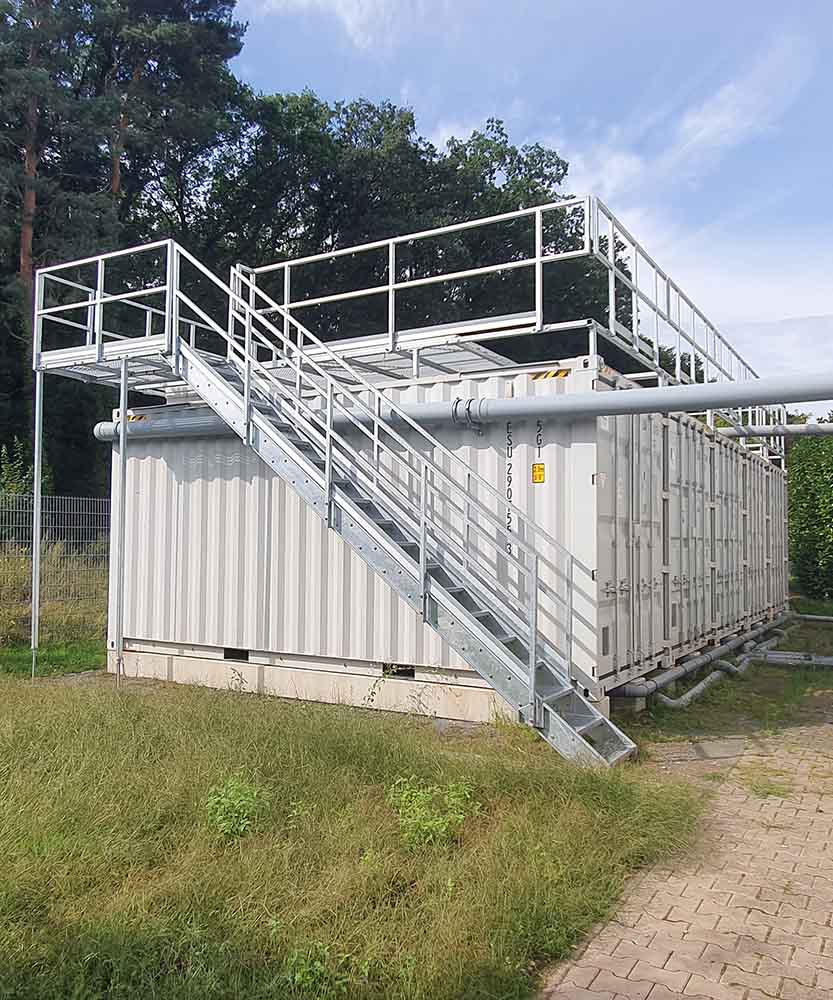

What is a containerised MBR?
A membrane bioreactor (MBR) combines a conventional activated-sludge biological process with membrane ultrafiltration (pore size around 0.02–0.04 µm). The membranes replace the secondary clarifier of a traditional plant, physically filtering treated water so that virtually all suspended solids and bacteria are held back.
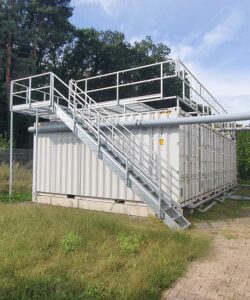
“Containerised” means the entire system — bioreactor, membranes, blowers, pumps, controls and electrics — is assembled, piped, wired and tested inside an ISO shipping container (20 ft or 40 ft) at our factory in Germany. The unit arrives on site as a plug-and-play package: position it, connect inlet, outlet and power, and commission. No civil works, no on-site tank building.
The result is the highest effluent quality of any common treatment technology, in roughly half the footprint of a conventional plant — water clean enough to reuse for irrigation, toilet flushing, dust suppression or process water.
Why choose a ClearFox® containerised MBR?
- Reuse-grade effluent — the highest standard available. Because ultrafiltration physically removes solids and pathogens, MBR produces water that typically meets or exceeds reuse standards. Stop discharging treated water — recover it. Ideal where water is scarce or discharge consents are tight.
- The smallest footprint in its class. MBR runs at very high biomass concentrations (MLSS ~8,000–12,000 mg/L vs ~3,000 mg/L conventional), so tanks are far smaller. Combined with the container format, you get a full treatment plant in a very small footprint. The only more compact system on the market is the ClearFox® FBBR.
- Truly plug-and-play. Factory-assembled, factory-tested, shipped complete. Commissioning takes days, not the months a concrete plant needs. Perfect for remote sites, fast project timelines, and locations with limited skilled labour.
- Modular and scalable. Need more capacity later? Add containers in parallel. Flow and load can grow with your development without rebuilding the plant.
- German engineering, certified quality. Designed and built by PPU Umwelttechnik GmbH to ISO 9001 and ISO 14001, with components and standards aligned to EN 12566-3 and European standards.
- Robust, enclosed and low-odour. All process steps are contained. The enclosed format suppresses odour and noise and protects equipment from the elements — important next to hotels, housing and worksites.
- Automated and remote-monitored. PLC control with remote monitoring/telemetry means fewer site visits, early fault alerts, and confident operation at unmanned sites.
- Proven worldwide. ClearFox systems operate across Africa, Eastern Europe, the Middle East and beyond, with over 50,000 systems installed worldwide.
How does the ClearFox MBR work?
- Screening / pre-treatment — coarse and fine solids are removed to protect the membranes.
- Biological treatment (bioreactor) — anoxic and aerobic zones use micro-organisms to break down organic load (BOD/COD) and, with denitrification/nitrification, remove nitrogen.
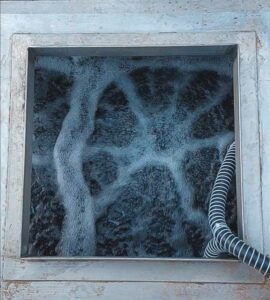
- Membrane filtration — immersed ultrafiltration membranes separate clean water (permeate) from the biomass. Air scour continuously cleans the membrane surface.
- Permeate (treated water) — clean, low-turbidity water is discharged or sent to reuse/storage.
- Automated cleaning — scheduled clean-in-place (CIP) maintains membrane performance over the long term.
Applications — where containerised MBR fits best
Hotels & resorts
Remote and off-grid hotels, lodges, resorts and tourist developments often have no sewer connection and strict environmental obligations near beaches, reefs or nature reserves. A containerised MBR treats all guest and kitchen sewage on site and produces reuse-grade water for landscape and golf irrigation, cutting freshwater demand and disposal costs — while keeping the plant compact, enclosed and odour-free out of guests’ sight and smell.
Residential developments & housing
For housing estates, gated communities, apartment blocks and mixed-use developments without municipal sewer capacity, an MBR delivers a decentralised plant that scales with phased construction. High effluent quality supports on-site reuse for communal irrigation and toilet flushing, and the small footprint frees up developable land.
Municipal & small communities
Villages, peri-urban settlements and small towns can deploy a containerised MBR as a fast, decentralised alternative to a large centralised works — meeting tightening discharge consents (BOD, nutrients, pathogens) without major civil construction. Modular trains allow capacity to track population growth.
Worker & labour camps (mining, oil & gas, construction)
Camps in remote regions need treatment that ships in, installs fast, survives harsh conditions and handles fluctuating occupancy. Containerised MBR is built for this: rugged, transportable, quick to commission, and able to recover water for dust suppression and non-potable use where every litre trucked in is expensive.
Industrial & commercial sites
Factories, food & beverage plants, logistics hubs and commercial campuses use MBR where space is tight, reuse is valuable, or discharge limits are demanding.
Effluent quality & water reuse
Typical ClearFox containerised MBR performance
| Parameter | Typical treated-water quality |
|---|---|
| BOD₅ | < 5–10 mg/L |
| COD | < 30–50 mg/L |
| Total suspended solids (TSS) | < 5 mg/L |
| Turbidity | < 0.2 NTU |
| Total nitrogen (with denitrification) | < 10–15 mg/L |
| Total phosphorus (with chemical dosing) | < 1–2 mg/L |
| Bacteria / pathogens | Substantially removed by UF membrane |
This quality typically supports water reuse for irrigation, toilet flushing, cooling, dust suppression and process water — subject to local reuse regulations [e.g. EU Regulation 2020/741, WHO guidance, US state standards].
Technical specifications
| Feature | Detail |
|---|---|
| Technology | Membrane bioreactor (MBR) — activated sludge + ultrafiltration |
| Container sizes | 20 ft / 40 ft ISO |
| Capacity range | From ~100 PE/PAX to large modular trains |
| Membrane type | Ultrafiltration, ~0.02–0.04 µm |
| Configuration | Pre-piped, pre-wired, factory-tested; plug-and-play |
| Control | PLC automation with remote monitoring |
| Standards / quality | ISO 9001, ISO 14001 |
| Scalability | Modular — add units in parallel |
Why ClearFox / PPU Umwelttechnik
FAQs
What does a containerised MBR cost?
Cost depends on capacity (population equivalent / m³ per day), required effluent quality and site conditions. As a guide, MBR has a higher capital cost than SBR or FBBR but a footprint equivalent to FBBR and the highest effluent quality, and it can pay back through water reuse. Request a quote for a fixed price for your project.
How quickly can it be installed?
Because the unit is factory-built and tested, on-site installation and commissioning typically take days once the unit is positioned and services are connected — far faster than a concrete plant.
Can the treated water be reused?
Yes. MBR is the technology of choice for water reuse. Treated water is typically suitable for irrigation, toilet flushing and non-potable uses, subject to local reuse regulations.
How big a plant can I build?
From small developments up to large communities — capacity scales by adding containerised modules in parallel.
What maintenance does an MBR need?
Routine checks, periodic membrane cleaning (automated CIP) and standard servicing. Remote monitoring reduces site visits. Membrane life is typically [X years — confirm].