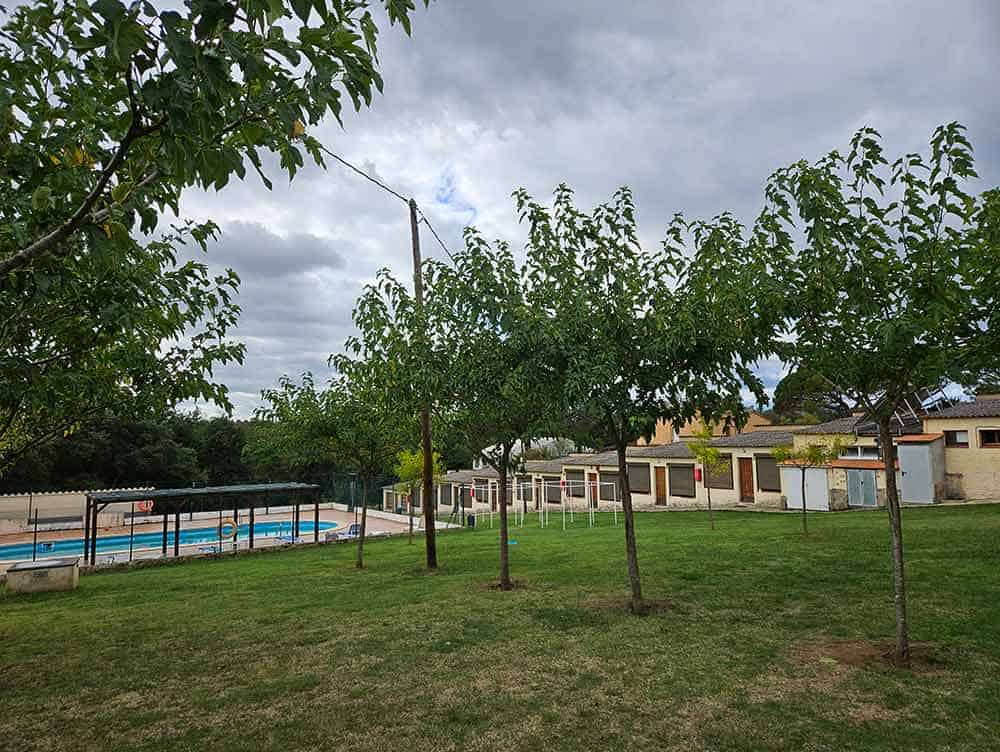
Holiday accommodation facilities shape large parts of the Catalan countryside. They serve as highly versatile venues – ranging from school camps and leisure programmes to private celebrations and weddings – and in their operation often resemble small rural hotels. As a result, the demands placed on infrastructure are equally diverse, particularly when it comes to wastewater treatment.
Such a facility near Girona, in north-eastern Spain, was facing an urgent need for action. The existing wastewater system was technically outdated and had effectively been reduced to the function of a holding tank. It no longer met current environmental regulations, nor did it satisfy the operational requirements of the site. The operator therefore sought a future-proof solution capable of reliably treating domestic wastewater from sanitary facilities, showers and kitchens.
Through our local partner Protecnia, PPU Umwelttechnik GmbH was brought into the project. The objective was to implement a modern, high-performance wastewater treatment plant that would be both reliable and discreet, and specifically tailored to the requirements of a holiday accommodation facility.
The key challenge of the project was the site’s remote location. Connection to a public sewer network was not possible, making a fully decentralised solution essential. At the same time, the new treatment plant had to significantly outperform the existing system, which was not only undersized but also operationally unreliable.
Another major factor was the highly variable wastewater load. The volume and composition of the wastewater fluctuate considerably depending on occupancy levels and the type of events hosted at the site. Daytime activities, multi-day camps and overnight guests all generate very different hydraulic and organic loads. Conventional systems designed for steady inflow conditions would not have been able to cope with these fluctuations adequately.
The close proximity of the planned treatment plant to the guest accommodation presented an additional constraint. For the operator, it was clear that noise emissions, odours or any visible technical structure were unacceptable. Ideally, the wastewater treatment system needed to remain virtually invisible and have no negative impact on the guests’ experience.
Strict discharge requirements further increased the complexity of the project. The treated effluent was to be discharged into a small nearby water body, necessitating particularly low effluent concentrations for COD, BOD, suspended solids and ammonium. The new system therefore had to combine operational flexibility with exceptionally high treatment performance.
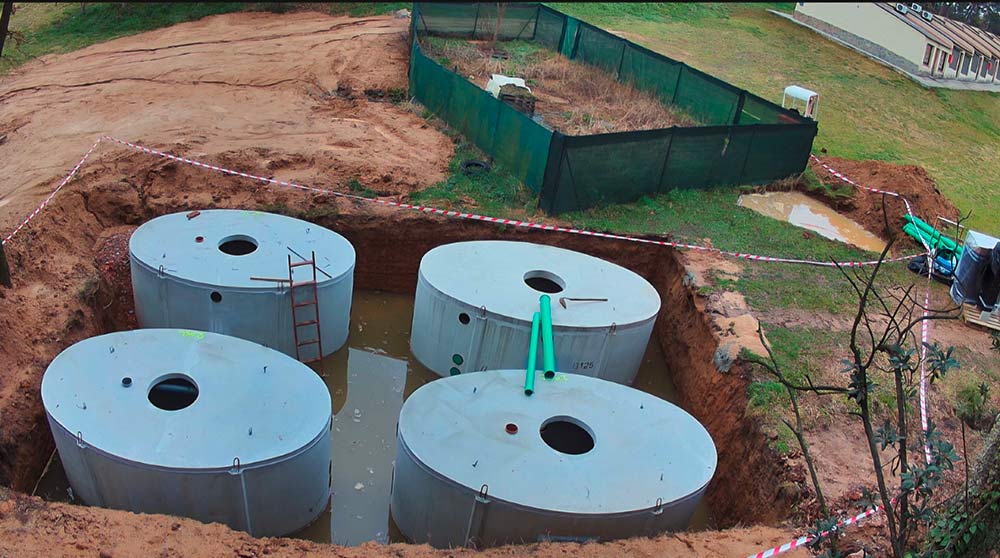
PPU Umwelttechnik implemented the project using an underground-installed ClearFox® QuickOne+ SBR system, designed for a capacity of 200 PE. The Sequential Batch Reactor (SBR) process is particularly well suited to applications with highly variable inflow conditions, as all treatment steps are time-controlled within a single reactor and can be flexibly adapted to the actual load.
The achieved treatment results clearly demonstrate the system’s performance. Influent concentrations of approximately 800 mg/l COD, 400 mg/l BOD₅, 467 mg/l TSS and 76 mg/l NH₄⁺ are reliably reduced to effluent values below 50 mg/l COD, below 10 mg/l BOD₅, below 15 mg/l TSS and below 1 mg/l ammonium. The plant thus fully complies with discharge class N requirements and enables safe direct discharge into groundwater.
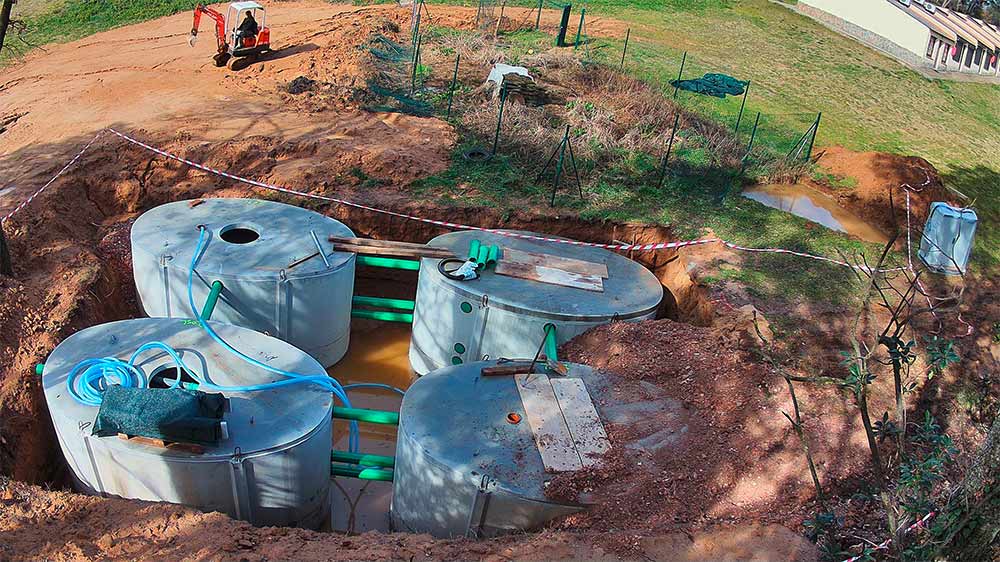
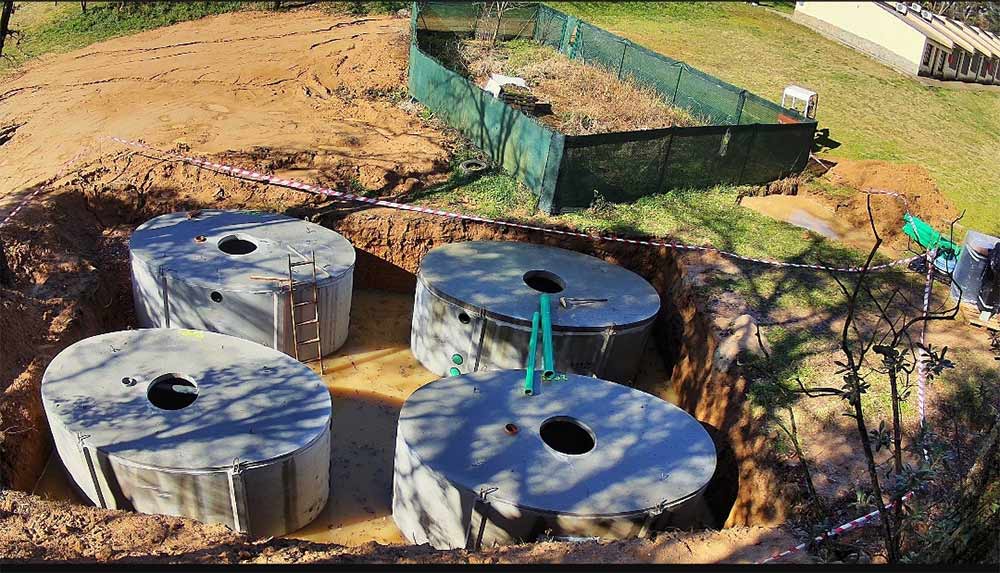
A key element of the project was the structural implementation. The SBR system was installed in four prefabricated, elliptical concrete tanks that are completely buried below ground. These tanks feature a high-quality construction: base slab and walls are cast in a single pour without joints, the cover slab is permanently bonded to the tank, and an integrated PE manhole ring protects the structure from the ingress of dirt and extraneous water during both construction and operation. Thanks to their robust design, the tanks offer long service life, excellent structural stability and are ideally suited for use in environmentally sensitive locations.
The underground installation ensures that the entire treatment plant remains visually unobtrusive – a decisive advantage in a holiday environment where landscape integration and guest comfort are paramount. Once the tanks had been installed, on-site work was limited to connecting the hydraulic components and power supply. The system was ready for operation immediately after installation, allowing the operator to continue running the facility without prolonged downtime.
Additional operational security is provided by an integrated remote monitoring system. A modem enables remote access to the control system, allowing PPU technicians in Germany to provide fast support when required. This reduces maintenance effort, increases operational reliability and gives the operator a high level of confidence and planning security.
With this project, PPU Umwelttechnik once again demonstrates how high-performance wastewater treatment technology, robust construction and discreet integration can be successfully combined – even under demanding conditions typical of holiday facilities and decentralised locations.
In most cases, yes. Underground SBR wastewater treatment plants such as the ClearFox® QuickOne+ are specifically designed for decentralised applications involving domestic wastewater – including holiday resorts, hotels, campsites, mountain lodges and event venues. Thanks to their modular design, plant capacity can be tailored precisely to the population equivalent (PE) and the actual load profile of your project.
The system is engineered to treat conventional domestic wastewater, i.e. effluents originating from toilets, showers, washbasins, kitchens and laundry facilities. Commercial or industrial wastewater streams containing elevated levels of grease, chemicals or other contaminants require individual assessment and, where necessary, pre-treatment.
No. The plant is designed as a fully decentralised solution. It is particularly well suited to sites without access to municipal sewer infrastructure – such as rural holiday facilities, eco-resorts or remote event locations.
Yes. Installation in underground concrete tanks is one of the system’s key advantages – especially in environmentally or visually sensitive settings such as holiday destinations. The entire treatment plant remains virtually invisible, blends seamlessly into the landscape and does not detract from the guest experience.
When properly designed and installed, odour and noise emissions are minimal. Underground installation, sealed tank construction and low-noise mechanical components ensure that the plant can operate even in close proximity to guest accommodation without causing disturbance.