Many municipal wastewater treatment plants in Germany were built in the 1980s and 1990s and still rely on process technologies that were considered state of the art at the time. While these systems have proven reliable over decades of operation, they increasingly struggle to meet today’s regulatory and operational requirements.
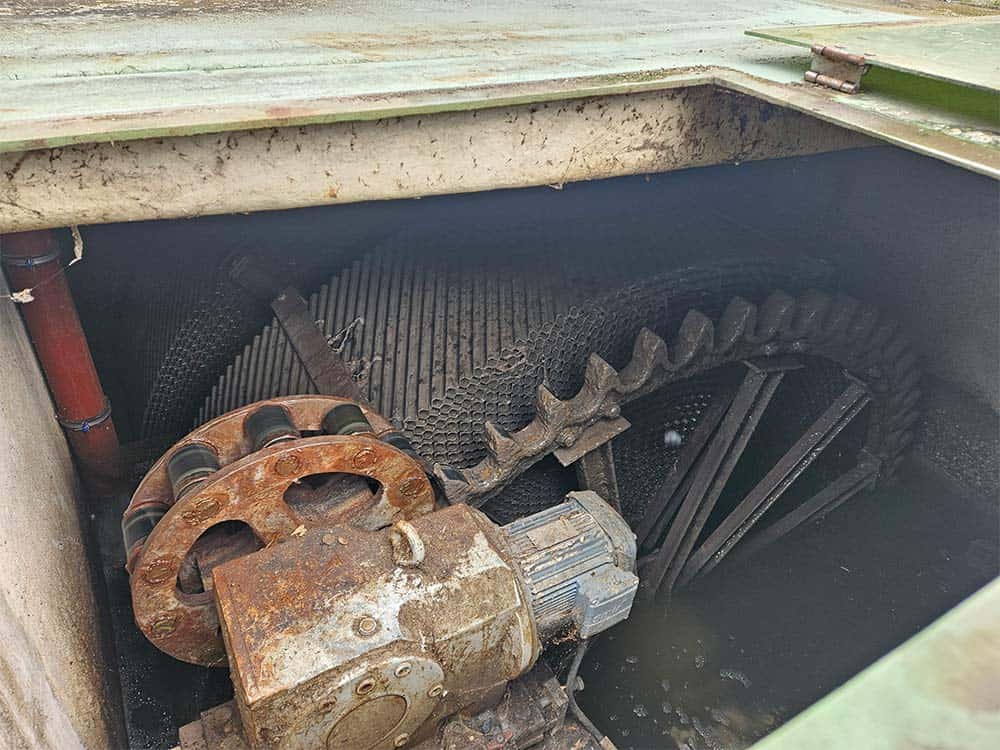
This was also the case for a municipal wastewater treatment plant in Bavaria. Designed for approximately 750 population equivalents, the plant treats between 80 and 130 cubic meters of wastewater per day. The biological treatment process was based on a rotating biological contactor (RBC), supported by a lamella clarifier for solids separation, a sludge holding tank, and a polishing pond for final clarification.
For many years, this configuration performed reliably. However, changing framework conditions began to place greater demands on the plant. Stricter discharge regulations, modifications to the sewer network, and altered influent concentrations required a higher and more stable biological treatment performance. The municipality therefore faced the challenge of upgrading the existing rotating biological contactor in a way that would be both efficient and sustainable, while keeping construction work and operational disruption to a minimum.
In the years leading up to the project, the plant repeatedly exceeded its ammonium discharge limits. The root cause was clear: the rotating biological contactor installed in the 1990s could no longer provide the required level of nitrification. The biological treatment stage was undersized for current loading conditions and was unable to maintain stable effluent values under the new regulatory framework.
Additional stress resulted from fluctuating influent characteristics caused by changes in the sewer system. As a result, the water authority demanded a prompt and reliable solution to restore compliance with discharge limits.
Several alternatives were evaluated. One option was the construction of a completely new wastewater treatment plant. Another was the installation of a pumping station to transfer the wastewater to a different facility. Both approaches, however, involved high capital expenditure, lengthy planning and construction phases, and significant interference with existing infrastructure. For a small municipality, these solutions were neither economically nor practically viable.
What was needed instead was a targeted and flexible approach to upgrading the rotating biological contactor—one that would enhance biological performance, make use of the existing infrastructure, and allow for future adaptability.
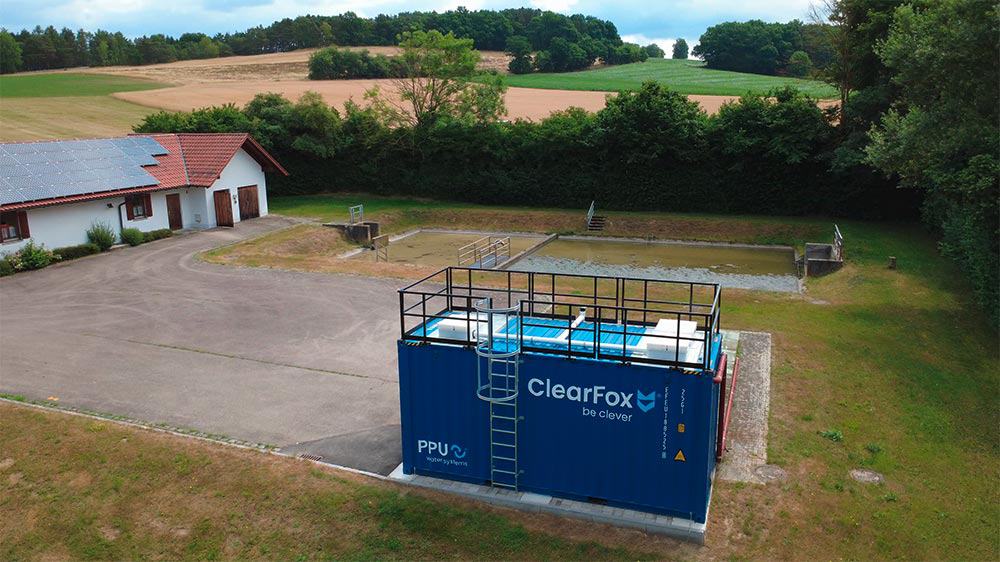
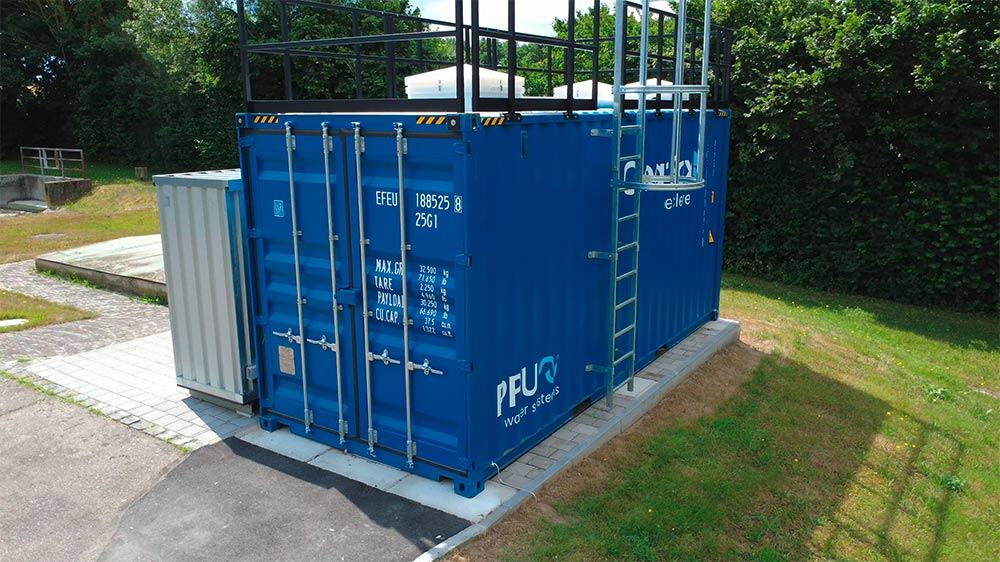
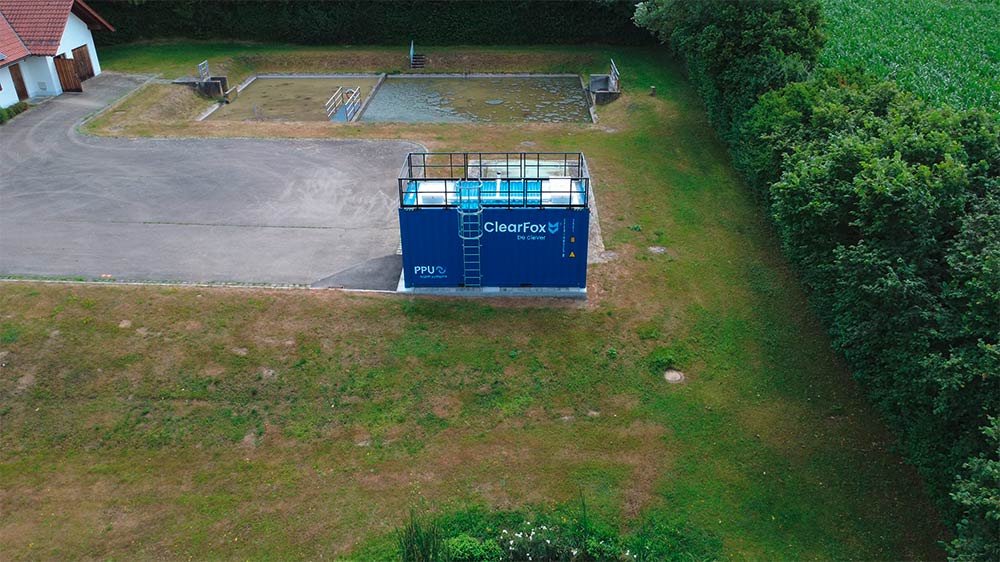
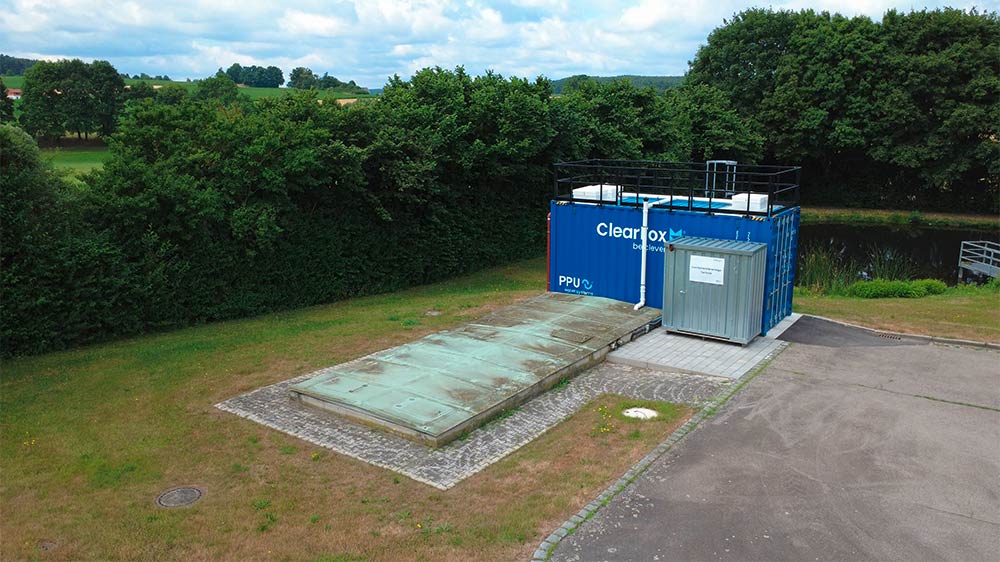
The municipality ultimately chose a modular container-based solution provided by PPU Umwelttechnik GmbH. As part of the project, a ClearFox® FBR fixed-bed container was installed as an additional biological treatment stage and seamlessly integrated into the existing process. Rather than replacing the rotating biological contactor, the goal was to relieve and supplement it, providing the missing nitrification capacity.
Wastewater is diverted from the process downstream of the RBC and conveyed to the ClearFox® fixed-bed reactor via a submersible pump. Inside the container, the wastewater undergoes advanced biological treatment. The reactor is filled with specially designed fixed-bed media offering different specific surface areas. These surfaces provide an ideal habitat for microorganisms, which—under continuous aeration—efficiently degrade organic pollutants and ensure stable nitrification of the ammonium load.
After treatment in the fixed-bed reactor, the clarified wastewater is returned to the existing final clarification stage. A partial flow is recirculated for denitrification, further reducing total nitrogen in the effluent. Excess sludge generated in the process is directed to the existing sludge holding tank, allowing the sludge line to remain unchanged.
A key advantage of this approach is that the entire existing treatment infrastructure remains in operation. The upgrade of the rotating biological contactor is achieved not through replacement, but through a targeted enhancement of the biological process. This avoided extensive civil engineering work, long plant shutdowns, and high investment costs.
In addition, the modular design of the ClearFox® system provides a high degree of flexibility. Should future regulations become more stringent or a complete replacement of the rotating biological contactor be required at a later stage, the system can be easily expanded with additional container modules. The solution therefore represents not only an effective short-term upgrade, but also a long-term, future-proof investment.
PPU Umwelttechnik delivered the project within a short timeframe, on budget, and to the full satisfaction of the municipality. Today, the wastewater treatment plant once again achieves stable ammonium discharge values and is well prepared to meet future regulatory challenges.
Yes. The ClearFox® fixed-bed container system is designed as a modular retrofit solution. It can be integrated into many existing wastewater treatment plants, especially those using rotating biological contactors, sewage ponds, or lagoon systems that no longer meet discharge limits.
No. In most cases, the existing RBC can remain in operation. The ClearFox® system is installed as an additional biological treatment stage, relieving the RBC and improving overall performance. A full replacement can be added later if required.
Absolutely. The system is particularly well suited for small to medium-sized plants where space, budget, and construction effort are limited. Typical applications range from a few hundred to several thousand population equivalents.
Integration is straightforward. The container is connected via pumps and pipes to the existing process, usually downstream of the biological stage or clarifier. Civil works are minimal compared to conventional upgrades or new construction.
Because the system is containerized and pre-engineered, installation and commissioning typically take only a few weeks. In many cases, the plant can remain in operation throughout the upgrade.
Yes. Fixed-bed technology is very stable and well suited to fluctuating hydraulic and organic loads. This makes it ideal for plants affected by seasonal variations or changing influent characteristics.
Yes. One of the key advantages of the ClearFox® concept is its modularity. Additional container modules can be added at any time to increase capacity or treatment performance, ensuring long-term regulatory compliance.